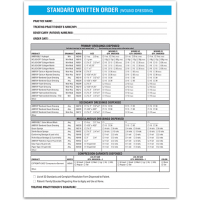
As of January 1, 2020, the DMEMAC requirement for a “Detailed Written Order” when ordering surgical dressings has changed to the requirement for a “Standard Written Order”.
Elements of a Standard Written Order
The required elements of a Standard Written Order are almost the same as those of the Detailed Written Order. The required elements of the Standard Written Order include:
- Beneficiary’s name or Medicare Beneficiary Identifier (MBI)
- Order date
- General description of the item
- The description can be either a general description (e.g., wheelchair or hospital bed), a HCPCS code, a HCPCS code narrative, or a brand name/model number.
- For supplies- In addition to the description of the base item, the DMEPOS order/prescription may include all concurrently ordered supplies that are separately billed (list each separately).
- Quantity to be dispensed, if applicable
- Treating practitioner name or National Provider Identifier (NPI)
- Treating practitioner’s signature
Consistencies
It is still unnecessary to write orders to ourselves. Most of us who provide surgical dressings function as both the prescriber and the supplier. As was the case with the Detailed Written Order, if the prescribing practitioner is also the supplier, a separate Standard Written Order is not required as long as all of the required elements of the Standard Written Order are documented in the medical record.
All mentions of the “Detailed Written Order” have been removed from the CMS website and replaced with “Standard Written Order”. These occurrences include the DMEMAC Local Coverage article, “Standard Documentation Requirements for All Claims Submitted to DME MACs,” the DMEMAC LCD, “Surgical Dressings,” and the DEMEMAC Local Coverage Article, “Surgical Dressings-Policy Article.”
DISCLAIMER: The information provided here is intended to educate health care providers regarding compliance for ICD, CPT, and HCPCS coding. The information provided does not guarantee reimbursement and is accurate to the best of our knowledge at the time of this publication. Coding guidelines can change and we encourage you to stay up to date. The existence of a code does not guarantee payment.