ICD-10-CM

The International Classification of Diseases, Tenth Revision, Clinical Modification (ICD-10-CM) is a standardized system used to represent diseases and medical conditions[1]. Healthcare providers typically use ICD-10-CM codes on claim forms to represent the pathologies they manage. The World Health Organization (WHO) owns and publishes ICD-10. The WHO has authorized the National Center for Health Statistics department of the Centers for Disease Control and Prevention (CDC) to develop ICD-10-CM. The National Center for Health Statistics publishes “ICD-10-CM Official Guidelines for Coding and Reporting,” which is updated every year and contains the guidelines needed to choose ICD-10-CM codes correctly[2].
ICD-10-CM “Official Guidelines”
Section I.B.2 of the “ICD-10-CM Official Guidelines for Coding and Reporting” states:
“Diagnosis codes are to be reported to the highest level of specificity.”2
Section I.B.18 of the “ICD-10-CM Official Guidelines for Coding and Reporting” states:
“Specific diagnosis codes should be reported when they are supported by the available medical record documentation and clinical knowledge of the patient’s health condition.”2
Section I.C.2 of the “ICD-10-CM Official Guidelines for Coding and Reporting” states:
“Verify that the correct code has been selected from the table and that a more specific site code does not exist.”2
Section IV.F.3 of the “ICD-10-CM Official Guidelines for Coding and Reporting” states:
“Code to the highest level of specificity when supported by the medical record documentation.”2
The ICD-10-CM guidelines are clear in stating that ICD-10-CM codes must be selected based on the highest level of specificity.
“Wound” Versus “Ulcer”
 When choosing ICD-10-CM codes, “wound” and “ulcer” are not synonyms. When it comes to diagnosis coding, a “wound” is something acute / traumatic and an “ulcer” refers to a break in the skin that fails to heal as it should and is chronic in nature.
The ICD-10-CM codes for “wounds” start with the letter “S”, placing them in Chapter 19 of the ICD-10 tabular index titled, “Injury, poisoning, and certain other consequences of external causes.” These S- codes should not be used to represent ulcers. Surgical dressings are usually used to address “ulcers.”
ICD-10-CM Ulcer Coding Options
Once it has been determined that the pathology addressed was an ulcer, the type of ulcer must be identified. The most common types of ulcers addressed with surgical dressings include diabetic foot ulcers, pressure ulcers, venous leg ulcers, and arterial ulcers. There are different coding mechanisms for each of these ulcer types. Diabetic foot ulcer coding begins with use of L97– codes. Venous leg ulcer coding begins with I83– codes. L89– codes are used for pressure ulcers and I70– codes should be used for arterial ulcers.
What If The Ulcer is Both Diabetic and Pressure?
 A diabetic patient with neuropathy may develop an ulcer on the dorsal proximal interphalangeal joint of a contracted 3rd toe. This ulcer could be considered a diabetic foot ulcer and / or a pressure ulcer. Thankfully, the National Pressure Injury Advisory Panel (NPIAP) provides guidance that clarifies this. For diagnosis coding, if there is an ulcer on the foot of a diabetic, it is considered a diabetic foot ulcer and therefore should be coded using an L97– code. This is true even if there is an arterial disease and/or pressure component.
Diabetic Foot Ulcers
The codes that represent diabetic foot ulcers to the highest level of specificity begin with:
- E08.621 (Diabetes mellitus due to underlying condition with foot ulcer)
- E09.621 (Drug or chemical induced diabetes mellitus with foot ulcer)
- E10.621 (Type 1 diabetes mellitus with foot ulcer)
- E11.621 (Type 2 diabetes mellitus with foot ulcer)
- E13.621 (Other specified diabetes mellitus with foot ulcer)
Each of the five “E” codes listed above carry with them this instruction:
“Use additional code to identify site of ulcer (L97.4-, L97.5-)”
This means an L97.4- or L97.5- ICD-10-CM code must be added to one of the five “E” codes listed above when coding a diabetic foot ulcer.
L97.4- Non-pressure chronic ulcer of heel and midfoot
L97.5- Non-pressure chronic ulcer of other part of foot
Whenever the word “and” is used in ICD-10 code descriptors it actually means “and / or.” Therefore, selection of an L97.4– code does not necessarily imply that the patient has two ulcers, one involving the heel and one involving the midfoot. Use of an L97.4– code could indicate an ulcer of the heel or an ulcer of the midfoot.
Both the L97.4- and L97.5- code stems require a 5th character. The 5th character options for L97.4- and L97.5- include:
0 – Unspecified laterality
1 – Right
2 – Left
Both the L97.4- and L97.5- code stems require a 6th character. The 6th character options for L97.4- and L97.5- include:
1 – Limited to breakdown of skin
2 – With fat layer exposed
3 – With necrosis of muscle
4 – With necrosis of bone
5 – With muscle involvement without evidence of necrosis
6 – With bone involvement without evidence of necrosis
8 – With other specified severity
9 – With unspecified severity
Selection of any of the “unspecified” options listed above would indicate that the documentation did not specify what it is supposed to allow selection of a more accurate, specific code. Use of these “unspecified” codes indicates the documentation was incomplete and should typically be avoided. Use of an “unspecified” ICD10-CM code normally indicates that the documentation did not contain the information needed to select the appropriately specific code. For example, the L97- ICD10-CM code options for a left plantar heel diabetic foot ulcer whose deepest depth of tissue exposed is subcutaneous tissue include:
L97.421 Non-pressure chronic ulcer of left heel and midfoot limited to breakdown of skin
L97.422 Non-pressure chronic ulcer of left heel and midfoot with fat layer exposed
L97.423 Non-pressure chronic ulcer of left heel and midfoot with necrosis of muscle
L97.424 Non-pressure chronic ulcer of left heel and midfoot with necrosis of bone
L97.425 Non-pressure chronic ulcer of left heel and midfoot with muscle involvement without evidence of necrosis
L97.426 Non-pressure chronic ulcer of left heel and midfoot with bone involvement without evidence of necrosis
L97.428 Non-pressure chronic ulcer of left heel and midfoot with other specified severity
L97.429 Non-pressure chronic ulcer of left heel and midfoot with unspecified severity
If the documentation of this ulcer were thoroughly and properly performed, it would include the fact that the deepest depth of tissue exposed is subcutaneous tissue. A selection of L97.429 would indicate that the documentation was incomplete and did not specify the severity of the ulcer. The more appropriate selection in this example is L97.422, reflecting the thorough documentation that did, in fact, specify the depth of the ulcer. Communicating to the payer that the documentation was incomplete can lead to claim denial and/or audit failure.
Similarly, selection of an L97- 5th character of zero (unspecified laterality) tells the payer that the documentation did not specify whether the ulcer was on the left or the right and this can lead to claim denial and/or audit failure.
Even after the E- code and the L97- have been selected when representing a diabetic foot ulcer, the coding may not be complete. The reason is E08.621, E09.621, E11.621, and E13.621 all carry with them the direction to “Use additional code to identify control using insulin (Z79.4) or oral antidiabetic drugs (Z79.84) or oral hypoglycemic drugs (Z79.84) or injectable non-insulin antidiabetic drugs (Z79.85)”. Therefore, coders must also use Z79.4, Z79.84, and / or Z79.85 if the patient is on any of these medications for diabetes. The order in which the codes are listed is important when instructed to “use additional code.” The appropriate Z- code should be listed immediately after the E- code. If the patient uses more than one of those types of medication, then multiple Z- codes should be used to represent each medication type. If the patient does not use any of those diabetes medication types, then none of those Z- codes should be listed.
Diabetic Foot Ulcer Coding Example
Patient with type 2 diabetes taking daily insulin for a chronic right lateral midfoot ulcer with muscle involvement without necrosis of muscle.
Start with L97.4– because this is a diabetic foot ulcer on the midfoot.
L97.4– 5th character is “1” because it is the right foot
L97.41– 6th character is “5” because there is muscle involvement without evidence of necrosis
That leaves the coder with a complete L97- code of L97.415, which carries the instruction to code first E11.621 (type 2 diabetes mellitus with foot ulcer) for this patient with type 2 diabetes who takes insulin daily. Because this patient uses daily insulin, Z79.4 is necessary as well. Following the rules of “code first” and “use additional code”, the order of these codes should be:
- 621
- 4
- 415
All three of those codes, in that order, are needed to properly represent a chronic right lateral midfoot ulcer with muscle involvement without necrosis of muscle in a patient with type 2 diabetes taking daily insulin.
Pressure Ulcers
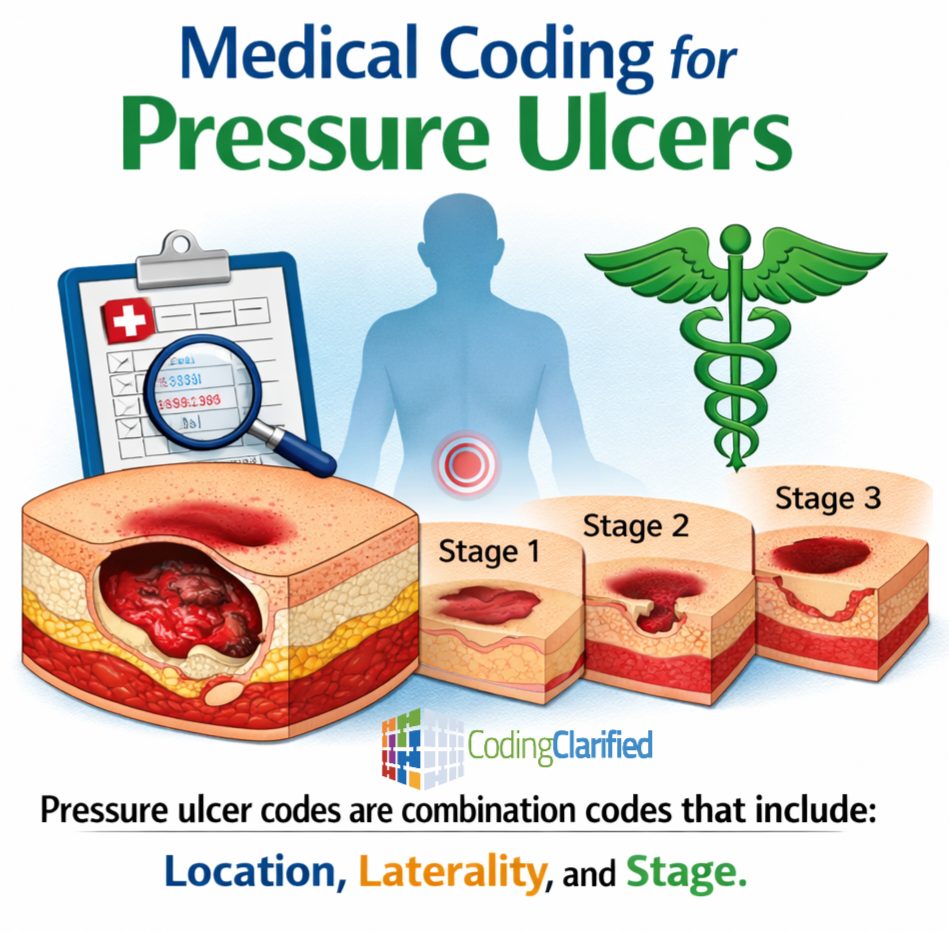 When coding a lower extremity pressure ulcer, start with the L89- codes. Do not confuse “other” and “unspecified.” For reasons stated earlier, it is normally best to avoid unspecified codes, but the use of “other” codes may be appropriate. The “other” option should be selected when the documentation specifies the location of the ulcer, but there is not a more specific code option offered in the code set to represent the ulcer location. An example of this is a pressure ulcer on a toe. This would not fall under the code pressure ulcer code options of ankle or heel. Therefore, the toe is considered an “other” site in the options listed below.
Pressure Ulcer of the Lower Extremity Code Stems
L89.51- Pressure ulcer of right ankle
L89.52- Pressure ulcer of left ankle
L89.61- Pressure ulcer of right heel
L89.62- Pressure ulcer of left heel
L89.89- Pressure ulcer of other site
All of these codes require a 6th character, with those options listed below. The “unstageable” option should be used when the deepest layer of tissue involved cannot be determined because it is covered by slough and/or eschar and it is not possible to stage the ulcer.
6th Character Options for Pressure Ulcers
0 – Unstageable
1 – Stage 1
2 – Stage 2
3 – Stage 3
4 – Stage 4
6 – Pressure-induced deep tissue damage
9 – Unspecified stage
These codes do not have any “use additional code” instruction and the only “code first” instruction is to “code first any associated gangrene (I96)”. If there is no associated gangrene this should not be included.
Venous Leg Ulcers
Venous leg ulcer codes begin with either I83.0– (Varicose veins of lower extremities with ulcer) or I83.2– (Varicose veins of lower extremities with both ulcer and inflammation). Both of these require a 5th character, and those options are listed below. The unspecified option should be avoided. If a patient had ulcers involving both the right and left extremities, both right and left code options should be listed. A 6th character is also required for these codes, and those options are also listed below. When looking at the 6th character option of “4” remember that “and” actually means “and / or”.
5th Character options for I83.0- and I83.2-
0 – unspecified lower extremity
1 – right lower extremity
2 – left lower extremity
6th Character options for I83.0- and I83.2-
1 – with ulcer of thigh
2 – with ulcer of calf
3 – with ulcer of ankle
4 – with ulcer of heel and midfoot
5 – with ulcer other part of foot
8 – with ulcer other part of lower leg
9 – with ulcer of unspecified site
All of these I83.0- and I83.2- codes carry the instruction to “use additional code to identify severity of ulcer (L97.-)”. This brings coders back to the L97.- codes discussed above. Remember with the “use additional code” instruction, the L97- code must follow the I83- code.
Arterial Leg Ulcers
Coding for arterial ulcers of the lower extremity starts with either I70.23– (Atherosclerosis of native arteries of right leg with ulceration) or I70.24- (Atherosclerosis of native arteries of left leg with ulceration). Both of these codes require a 6th character, and these 6th character options are the same as those listed for venous leg ulcers above. Similar to venous leg ulcers, with these arterial ulcer codes coders must “use additional code to identify severity of ulcer (L97.-)”. If arterial ulcers are present on both right and left lower extremities both codes should be listed.
Wounds
Codes for what ICD-10-CM considers to be “wounds” start with the letter “S”. Codes for open wounds of the ankle start with S91.0-. Codes for open wounds of toes without damage to the nail begin with S91.1– and codes for open wounds of toes with nail damage start with S91.2-. For an open wound of the foot, codes start with S91.3-. These codes all require a 5th character, and those 5th character options are listed below. All of these codes also require a 6th character. The 6th character options for the S91.0- codes are “1” for right ankle and “2” for left ankle. The 6th character options for the S91.1– and S91.2– codes are more extensive and are listed below. The 6th character options for the S91.3- codes are “1” for right foot and “2” for left foot. Remember the recommendation to avoid the unspecified codes.
TABLE 7 – 5th Character Options for S91- Codes
0 – Unspecified open wound
1 – Laceration without foreign body
2 – Laceration with foreign body
3 – Puncture wound without foreign body
4 – Puncture wound with foreign body
5 – Open bite
TABLE 8 – 6th Character Options for S91.1- and S91.2- Codes
1 – right great toe
2 – left great toe
3 – unspecified great toe
4 – right lesser toe(s)
5 – left lesser toe(s)
6 – unspecified lesser toe(s)
9 – unspecified toe(s)
Finally, all of these S- codes listed above require a 7th character. The 7th character options are A, D, and S. “A” should be used in the 7th character position if active care was provided during that visit. “D” should be used as the 7th character if the care provided can be considered follow up care. The selection of A or D has nothing to do with whether the patient has been seen by this doctor in the past or whether or not it is the first time the patient has been seen for this problem. The selection is based solely on what type of care was provided.
DISCLAIMER: The information provided here is intended to educate health care providers regarding compliance for diagnosis coding. The information provided does not guarantee reimbursement and is accurate to the best of our knowledge at the time of this publication. ICD10 codes and guidelines can change, and we encourage readers to stay up to date. The existence of a code does not guarantee payment.
Author: Jeffrey D. Lehrman, DPM, FASPS, MAPWCA, CPC, CPMA, CEMC
Co-Authors: Joshua Trujillo, Katelyn Norkowski
Clinical References:
[1] https://www.cdc.gov/nchs/icd/icd-10-cm/index.html
[2] https://ftp.cdc.gov/pub/Health_Statistics/NCHS/Publications/ICD10CM/2025/icd-10-cm-FY25-guidelines-october%20-2024.pdf